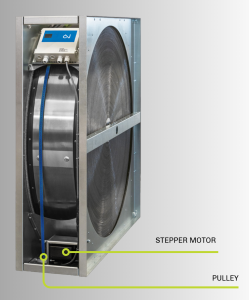
 Pulley and Motor Size
The important thing to keep in mind when thinking about pulley size is that you don’t want to use a larger pulley than you need. Your actual pulley should be a little larger than the minimum size you calculate, but only the next size up.
Here’s How to Get There, Step by Step.
STEP 1
Determine Your Desired Rotor Speed
The speed you’ll want your rotor to turn at depends on the type of rotor you have chosen and other factors specific to your exact setup. If in doubt, we recommend talking to the manufacturer of your rotor.
STEP 2
Calculate Your Ideal Speed Ratio
Your ideal speed ratio, or gearing, is the ratio between your rotor speed and the speed at which you want the motor to run. To calculate this, divide your maximum desired rotor speed by the maximum speed at which you want your maximum desired motor speed.
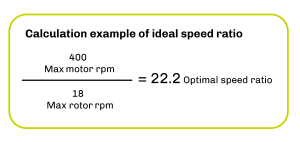
The result is your optimal speed ratio.
STEP 3
Determine Your Minimum Pulley Size
To determine the minimum pulley size for your setup, you’ll need to perform another calculation – this time dividing your rotor diameter by the speed ratio you arrived at under Step 2.
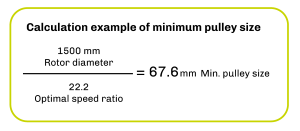
STEP 4
Choose Your Pully Size and Recalculate Speed Ratio
Pulleys come in fixed sizes, and you will always want to choose the next available size up from the minimum size you calculated in step 3. If you go any higher, your pulley will be too large, and this will cost you performance. Once you have chosen the next size up – let’s say 75 mm based on your 67.6 minimum – you will want to recalculate your actual speed ratio.
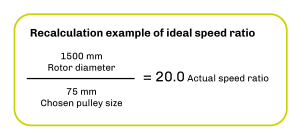
Congratulations!
You now have your chosen pulley size – 75 mm – and calculated your actual speed ratio. But while we’re at it, let’s look at one more factor – desired motor torque – and how to calculate your way to the right-sized OJ MRHX motor and DRHX drive.
STEP 5
Determine How Much Torque Your Motor Should provide
After you know your pulley size, you’ll want to decide how much torque your motor needs to provide at a minimum. To do this, you’ll need to calculate your desired rotor torque – and this is not always easy if you lack calculations from previous setups.
If you have previous calculations, use them. If not, talk to OJ about the option of connecting a DRHX drive (must be large enough to drive the MRHX motor with certainty) and using OJ’s DRHX PC Tool to make your selection.
For a rough estimate of your required rotor torque, use the chart below.
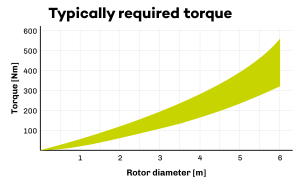
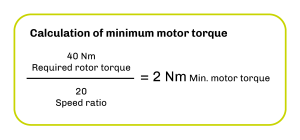
Once you have your required rotor torque, simply divide this by your actual speed ratio to calculate your minimum motor torque.
IMPORTANT!
Now you will need to add a margin – we recommend 25% – to the result to cover any torque variations you may experience. Then you’ll be ready to choose the right OJ Electronics MRHX motor and DRHX drive.
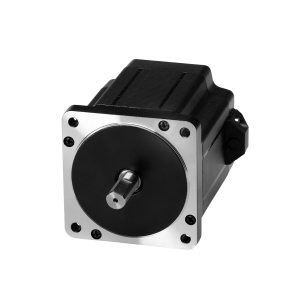
In our example, this means you will need a 4 Nm motor.