
Let’s Start with the Pros and Cons to Installing Controllers in the Field.
The Field-Installed Approach
There’s a lot to be said for choosing to install your AHU controllers on site at a given building or building complex. First, this approach means all AHU control algorithms can be gathered in the building’s building management system (BMS), centralizing all control functionality in a single system from a single supplier.
One advantage of this is that facility managers can easily access and monitor all AHUs on one BMS screen via the same interface regardless of AHU brand. Another benefit is that all similar AHUs in the BMS – even those from different producers – can be operated via the same generic control algorithms. Plus, all AHUs in such a setup can share the same control strategy and performance.
BMS systems themselves are very flexible and can easily be modified to accommodate new requirements during the building’s lifetime. Likewise, the AHU control algorithms used can be adapted to meet future demands. And of course IT security updates apply to all components in the BMS system – including the PLC used to control the AHU.
The Downsides of On Site
Of course there are also disadvantages to the install-on-site approach. Proprietary BMS systems are often only serviced and updated by the original supplier, and changing suppliers requires a large investment in a new BMS system from another manufacturer. What’s more, system integration costs are largely based on the total number of data points, which can really add up with full integration of all AHU sensors and components.
With a field-installed approach, AHU commissioning can be complex – as field installed controllers can include incorrect wiring, wrong components, the need to move components already installed, and some modification of control algorithms. Then there is the required rewiring and programming of controllers upon expiry of the BMS system or other components, complications that arise from the comparatively short lifecycle of BMS systems, and potential unstable operation or disturbances connected with electromagnetic compatibility – even among components that are all CE-approved.
In other words, there are many hidden complexities and costs associated with the field-installed approach.
Why OJ Chooses Factory-Installed
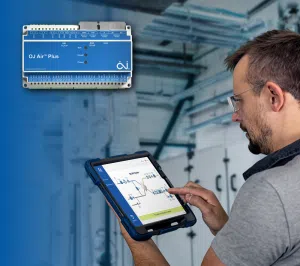
At OJ Electronics, we design our AHU controllers for easy integration into the AHU at the factory, prior to installation on site.
There are many reasons for this, including:
1. Guaranteed Performance.
With a factory-installed system, controller settings are optimized in collaboration with your experts to suite each individual AHU. This means guaranteed performance without the risk that goes with generic algorithms and settings dialed in by installers.
2. Lower Investment.
It’s more efficient to install controllers on an AHU assembly line than at a construction site. All required datapoints will have already been entered in the user interface and BMS protocols, and the cost of BMS integration is very low.
3. Lower Operation and Service Costs.
A detailed, built-in alarm system provides precise fault information, making it easier to identify malfunctions quickly. This allows service technicians to troubleshoot issues more efficiently.
4. Year-Round Reliability.
The complete AHU design, including the controller, has been optimized and tested during the manufacturer’s product development process. This ensures many years of reliable year-round operation right from day one.
5. Fast Commissioning.
The AHU (including controller) is factory-tested with all components pre-wired and verified for proper operation. This eliminates the need for on-site wiring and configuration of sensors and other components.
6. Easy and Affordable Updates.
The AHU controller can be updated with new features, with no costly changes to the BMS. This allows AHU manufacturers to offer long-term value, extend product lifecycles, and stay competitive.
7. Freedom to Choose Among AHU Brands.
Open BMS interface protocols (BACnet, Modbus) allow different AHU brands to be used on the same BMS network, eliminating the risk of being locked in to a single supplier.
Factory-Installed isn’t Always Perfect…
Despite all the positives, the factory-installed approach to controller integration can also have downsides. BMS integrators cannot modify the software in a factory-installed AHU controller. Only the AHU manufacturer can introduce new features or updates – and only they can guarantee performance, which may limit flexibility for some system integrators.
… but we’re convinced it’s the better choice.
“OJ Electronics settled on the factory-installed controller model years ago. We did so because we believed – and remain convinced – that factory-installed is the better option for most buildings. Less complicated. Faster. More affordable.
We also believe that the experts who design your AHUs know best how their controller should be configured. Choosing a supplier who will work closely with them to integrate and set up their controllers in the factory will nearly always produce the best results.”
Mogens Jørgensen, Product Manager Controls