Yet these highly visible fields account for only a fraction of the engineering work being done. And technologies that never make the headlines can be far more complex – and more challenging – than anyone looking at the finished product might imagine.
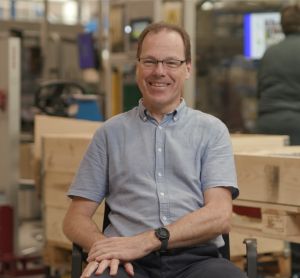
Jörn Petersen, an embedded software engineer at OJ Electronics, has a simple way of putting it. “Well, we don’t build rocket ships,” he says. “So no, it’s not rocket science in the traditional sense. But it is another kind of rocket science – the kind you only discover when you start digging into the details.”
OJ develops fan drives, controllers for air-handling units, and thermostats for electric floor-heating and ice- and snow-melting systems. None of this is likely to appear on the front page of a technology magazine, but as Jörn points out, appearances can be deceptive.
“A lot of what we make looks simple. Then you get into the details and discover just how much has to work together – hardware, software, control, communications, testing, the real-world environment. That’s where the complexity starts to show.”
Jörn Petersen, Embedded Software Engineer
“Thermostats have come a long way from simply going “click and clack.”
Morten Zimmer Hansen, Product Manager

A Thermostat and So Much More
Consider the OJ product that most people around the world are likely to actually see: OJ thermostats for floor heating systems. There was a time when their basic job was relatively straightforward – measure the temperature and switch the heating on or off. As product manager Morten Zimmer Hansen puts it, thermostats have come a long way from simply going “click and clack.”
Today, temperature regulation is just one function these devices are responsible for. One of the company’s latest models combines a large color touchscreen with heating and cooling control, humidity sensing, Wi-Fi connectivity, cloud communication and integration with smart-home ecosystems.
Even cooling a room through the floor creates an engineering problem most homeowners will never know exists. Pump cold water through a floor on a warm, humid day and the surface can fall below the dew point, causing condensation. OJ’s solution incorporates a humidity sensor and calculates the dew point continuously to keep the floor temperature above that critical level.

“Think about how much technology we’re putting into something this small. There’s a microprocessor in there – basically a computer – plus sensors, software, connectivity and all the intelligence needed to make it work properly.
And around that small device sits an increasingly large technological ecosystem: Apps, cloud services, third-party APIs and connections to platforms like Amazon Alexa, Google Home, and Apple HomeKit.”
Morten Zimmer Hansen, Product Manager
Making Tough Stuff Look Easy
The same principle applies to OJ’s drives. Project manager Brian Skov describes them as products with a great deal of complexity hidden behind apparent simplicity. “There’s a huge amount of engineering and know-how packed into them,” he says. “You’re trying to get high performance out of a relatively small drive without creating too much heat, too much electrical noise, or other problems.”
That apparent simplicity is part of the product as a whole. A customer shouldn’t have to see all the engineering that went into making the drive. Ideally, the drive simply does what it’s supposed to do, reliably and efficiently, inside a much larger system.
Brian compares it to the old story about the bumblebee. “It shouldn’t really be able to fly – but somehow it does.”
“There’s a huge amount of engineering and know-how packed into our products.”
Brian Skov, Project Manager


Out of The Lab
Of course, getting something to work in the lab isn’t the same as getting it to work everywhere. “Our software doesn’t live in an ideal world,” Jörn says. “Out in the field, you meet conditions that are very different from the ones you can create in a laboratory – and some of them are very harsh indeed.”
A product can meet its specifications perfectly in testing and still encounter a combination of conditions nobody anticipated once it reaches the customer. A drive can be installed thousands of kilometers away on an electrical supply with disturbances or imbalances. It might have to operate in heat, moisture or dirt. Or form part of a system built from equipment supplied by several different manufacturers.
That can turn engineering into detective work. “The first challenge is often to reproduce the problem,” Jörn says. “Once you can create the same conditions in the lab, you can start working out what’s actually happening and how to fix it.” Sometimes that means solving problems nobody knew existed when the product was designed.


